


At Tender Mercy
O lone streetlight,
Trying to shed
What light you can
On a spider repairing his web
This autumn night,
Stay with me,
As I push further and further
Into the dark.


from Scribbled in the Dark (Ecco, 2017)
Imagine this. Two poets go walking in the middle of the night. It’s a cool night, breezy, maybe the first night that feels like fall. Maybe, briefly, out of the corner of their eyes, they catch a leaf twirling in the space between the moon and puddle that holds the moonlight. Maybe they turn to see this leaf, both of them, and are met with the river, over there, yes, a mile wide and blueblack, with a thousand sailboats made of starlight, all of them gentle and bobbing, outlining the evening’s first waves. Imagine these poets older. Imagine them white-haired. Imagine a thousand poems behind them and only a few more ahead. You’re walking slower now, aren’t you? That’s okay. Take your time. Now imagine them no longer together. One is alone and the other is alone. And it is the same night but they are each somewhere else. As you are to me now. As I am to you.
One of those poets is Charles Simic. He is walking and he is thinking and he is writing. And he sees that leaf fall between the moonlight and the street. And he walks further along. And he sees a streetlight, and he writes, addressing it:
Stay with me,
As I push further and further
Into the dark.
The other poet, walking somewhere else, is Jack Gilbert. I think he is looking down. I think maybe sometimes he is looking up. I think he is by himself. And I think he is wondering aloud, in the midst of that solitude, which maybe is bordering on loneliness. His wondering reads like this:
Can you understand being alone so long
you would go out in the middle of the night
and put a bucket into the well
so you could feel something down there
tug at the other end of the rope?
That’s Gilbert’s poem, “The Abandoned Valley,” in full.
I love these two poems sitting right next to each other. I love imagining the fact of their creation. I love that they are poems about being alone in the middle of the night. And I love that they are poems about need. For Simic, such need begs for a holding-on. Stay with me, he writes, as if his speaker-walker has just stumbled upon a companion. And for Gilbert, such need begs for a reaching-toward, the putting of “a bucket into the well.” Reaching downward. Hoping for something, someone, to “tug at the other end of the rope.”
I think that part of the work of life is the work of patchworking-together some salve against loneliness. Simic begins his poem with loneliness itself, ascribing such a quality to a streetlight:
O lone streetlight,
Trying to shed
What light you can
And loneliness, too, is the kind of thing, as Gilbert writes, that makes you long:
[to] put a bucket into the well
so you could feel something down there
tug at the other end of the rope
And loneliness, finally, as the late Fanny Howe writes, is a feeling much like shame, from which “nothing great happens.” She writes more:
Nothing great happens as a result of loneliness.
Your character flaws remain in place. You still stop in
with friends and have wonderful hours among them,
but you must run as soon as you hear it calling.
It does call. And you climb the stairs obediently,
pushing aside books and notes to let it know that you
have returned to it, all is well.
If you don’t answer its call, you sense that it will sink
towards a deep gravity and adopt a limp.

From loneliness you learn very little. It pulls you
back, it pulls you down.
I hear echoes of Gilbert’s poem in Howe’s final lines here. The loneliness that makes someone look down into a well, and reach and reach and reach. What good happens there? When you know nothing but loneliness and, knowing only loneliness, you go searching for anything to pull against the other end of you? Even if it’s pulling you down. Even if it’s pulling you all the way down.
But I think, too, of the title of Simic’s poem: At Tender Mercy. And I think about this poem’s approach to loneliness. While Gilbert’s poem captures the inherent need for just about anything in the midst of loneliness (he never says, in fact, what is at the bottom of this well, if it’s water or if it’s something else, or if it’s full or if it’s not, because pulling up an empty bucket still requires pulling against the force of gravity), Simic’s poem captures an almost radically empathetic approach to one’s own loneliness, which requires seeing the experience of such loneliness in just about everything.
Read it again:
O lone streetlight,
Trying to shed
What light you can
On a spider repairing his web
This autumn night,
Stay with me,
As I push further and further
Into the dark.
The poem begins with an acknowledgment of another’s loneliness, and then the acknowledgment of an act of care — the spider “repairing his web.” And then, from there, from those two acknowledgments, the poem asks for something, something beautiful: Stay with me.
These two poems, taken together, offer two distinct approaches to loneliness. One, illustrated in Gilbert’s poem, is an approach that is entirely individualistic. You feel lonely. You go out alone. You put a bucket in a well. It fills up or it doesn’t. It drags you down or you pull it up. Whatever happens, you’re still alone. And the other approach, illustrated in Simic’s poem, is an approach that seeks the company of others. You feel lonely. You go out alone. You pay attention. Everything is charged with its own kind of soul. Even an object. Even a spider. You ask for help. You ask for company. Maybe you still feel lonely, but you are not alone anymore. Look at today’s poem’s titles. At Tender Mercy. The Abandoned Valley. They are opposites, aren’t they? Mercy requires communion. Abandonment is the end result of alienation.
As I have mentioned a few times before, when Hanif Abdurraqib came to speak with my students one year, he offered the idea that what we do with our loneliness — and as a result of it — is perhaps, the central question of our life. How we cope with it. How we acknowledge it. How we run from it. He said that almost two years ago and I still think about it. And I think that it has been true for a long time and is particularly true now.
I love Gilbert’s poem above because it feels particularly honest. And in such honesty, it expresses a particular danger — the danger of doing just about anything to feel just about anything in a world where one’s loneliness gives rise, quickly, even exponentially, to nihilism. You know as well as I do that well we go to, in Gilbert’s poem, to feel something as a way to cope with our loneliness. At the low stakes end of it, it is the workout where you destroy yourself just to feel the blood throbbing in your veins. The shot you take at the bar when all you told yourself you were having was a beer. The secret cigarette you smoke. But as the stakes grow higher, the well’s water changes. It’s the sleepless night you spend scrolling. The self harm. The violence you consume that begins to mean nothing to you, vast and endless as it is. It’s the loss of specificity. It’s generalized anxiety. It’s the strange absurdity that sets over a life soundtracked by doom’s low warble. The well we go to becomes the well we live in. The walls too high to even believe there’s light.
Simic’s poem moves me deeply because it insists on connection. In fact, much of Simic’s work does the same. Here are the opening lines of his poem “The Lifeboat,”
That cow left alone tonight
Out in the fields
Does it look up at the stars?
And here’s his aptly-titled poem “Solitude,” in full:
There now, where the first crumb
Falls from the table
You think no one hears it
As it hits the floor,

But somewhere already
The ants are putting on
Their Quaker hats
And setting out to visit you.
(Absolutely adorable, to be quite honest).
For Simic, the work of poetry is the work of reminding oneself that we cannot — cannot ever be — alone. This takes conscious work, I’d argue. It is an act of listening, of empathy, of attention. In order to imagine a streetlight lonely, you must first see the light, and then you must see what is giving the light. This is no small feat in this contemporary moment. In order to have empathy for someone, you must see them first. In order to mystify an image, to make it unfamiliar, to reach into metaphor as an attempt at meaning, you must notice the image first, and you must notice, too, whatever you connect it to.
There’s a deep, involved sense of attention that this requires, and the longer I live in this current world, the more I think that our culture of doomscrolling and memeification and hyper-fast news cycles do a different kind of work. Such structures in our world reinforce the opposite of attention; they take what has happened — whatever event, whatever shock — and spin it quickly into a language we understand rather than one we don’t. They spin it into trolling jokes, viral posts, more and more of the same. The easy to digest or easy to ignore. The work of poetry involves, in some cases, mystifying one’s reality in order to clarify the very fact that it is okay not to know, that it is okay to be unsettled, that it is okay to be somewhere in the midst of doubt. That work begs us to connect on lines that have more to do with something deep within ourselves and less to do with something on our surface. It begs us, too, to make decisions from a place of involvement, which means, I think, that our decisions will be more in line with a kind of justice and solidarity.
I think Simic would also say that the work of poetry is the acknowledgment of one’s need for mercy. Indeed, he says as much in an interview with The Paris Review shortly before his death:
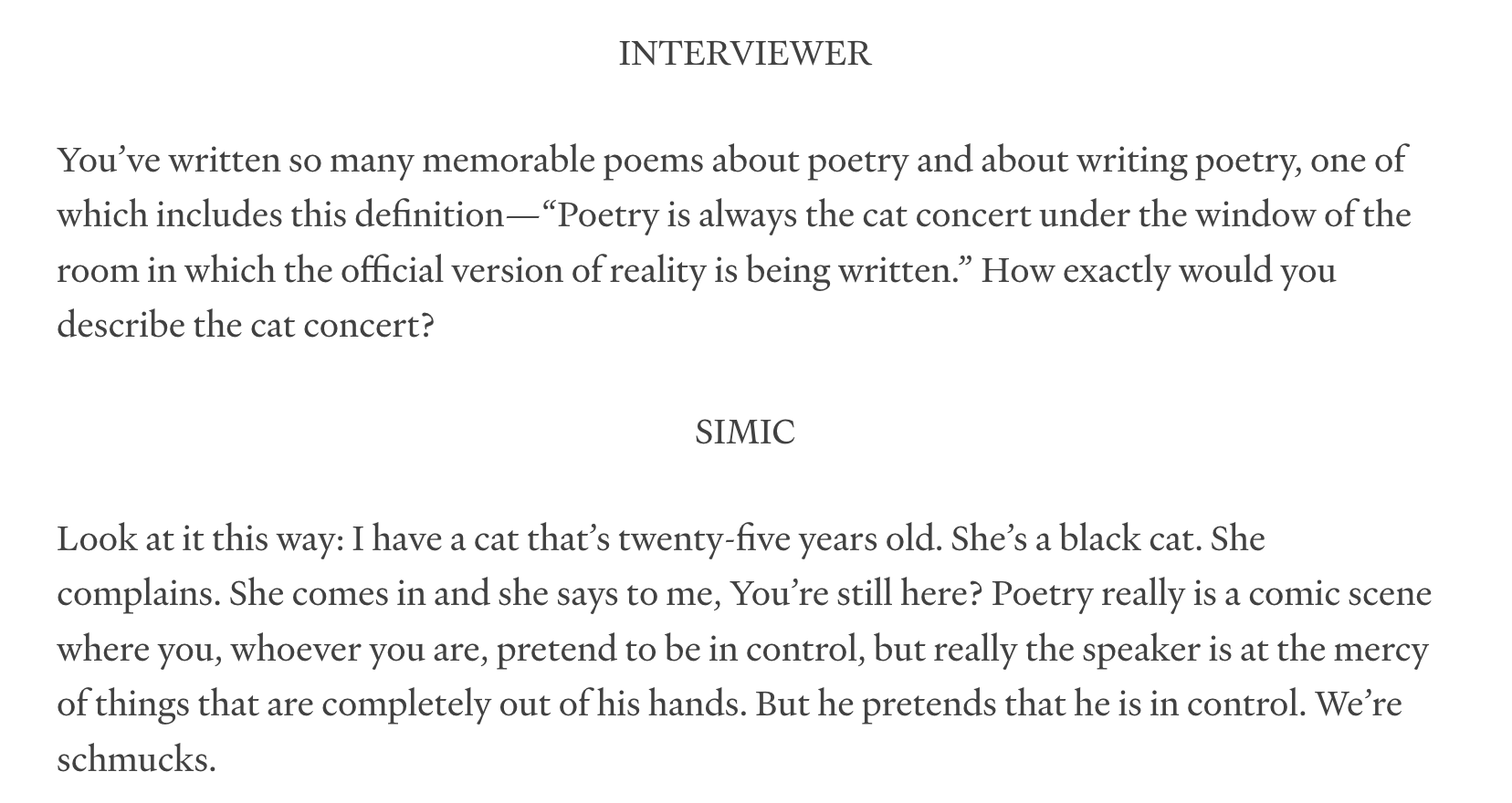
I love this. It’s funny, absurd, lovely, gentle, and beautiful. It reminds me that one way to cope with the difficult and strange absurdity and fragility of life is to smile, head tilted, at the world as it comes walking into the room of where you are.
Perhaps I am wrong to focus so much on loneliness in these words. Perhaps it might be better to reframe our fundamental loneliness as something else. Perhaps it might be better to say that we are, each of us, fundamentally in need. Which means that we are, in every interaction and every connection we make, at the mercy of someone else who is also in need. We are creatures in need meeting creatures in need. Our solution, then, must be one another. We can build our own wells in our own yards and drink, alone in our own houses, the same poisoned water. Or we can go out in the middle of the night and stand together under the same streetlight and watch the same spider repair his web. And one of us might try to leave a little early and another of us might touch their hand. Stay with me, they’ll say. Don’t go yet.
It is scary, right now, to be alive. I imagine it always has been. There is so much to wrestle with — one’s own mortality, one’s own doubt, the failure of everything to completely solve anything, each day’s steady unraveling of certainty, and what we witness, every second, of violence, whether fast or slow or personal or genocidal or systemic or structural. Stay with me, then. Because I am afraid. And admitting one’s fear is the first step to being open to another’s mercy.1
The week before last, I spent an hour on a video call with members of the Gaza Sunbirds this past week for an article I am working on for Outside Magazine. Here is a link to their Instagram, which broadcasts the work they are doing in Gaza, and the accomplishments of their cyclists (all of whom have amputations as a result of ongoing Israeli violence against the people of Palestine) as they try to compete on the world stage. I have mentioned their work before on here; it is powerful, hopeful, beautiful, and brave. It shouldn’t have to be any of those things, but it is.
I have found that Writers Against the War on Gaza is doing great work in building solidarity and awareness and justice in this contemporary moment. You can find a list of their resources and areas of further support here. Please consider following and supporting the work of The Sameer Project (link here) as they provide on the ground support for Palestinians in Gaza.
My novel, Pilgrims, has a cover, a release date, and a preorder link. It’ll be out November 18th. You can preorder it here. And the cover is below. For all of this, I am wildly grateful. This novel, which tells a story of monks and brothers and dogs and bread-makers and long roads, feels like a big chunk of myself. And I’d be honored if you read it.
If you’ve read any of the recent newsletters, you’ve perhaps noticed that I am offering a subscription option. This is functioning as a kind of “tip jar.” If you would like to offer your monetary support as a form of generosity, please consider becoming a paid subscriber below. There is no difference in what you receive as a free or paid subscriber; to choose the latter is simply an option to exercise your generosity if you feel willing. I am grateful for you either way. Thanks for your readership.
By the way, and I am putting this in a footnote because I don’t particularly want to contribute (though now I am) to the now-bordering-on-toxic news cycle pertaining to Charlie Kirk’s death, but in light of a New York Times opinion piece by Ezra Klein titled “Charlie Kirk Was Practicing Politics the Right Way,” and how it made the case that Kirk “was showing up to campuses and talking with anyone who would talk to him,” I’d just like to say that it is mercy itself that Kirk’s politics was missing, and mercy itself that so much is missing right now. Kirk was practicing politics in a way that made a show of free speech while building systems, such as a watchlist that tracked professors whose views he disagreed with, that degraded the very idea of free speech.
One can absolutely abhor the gruesome and cruel nature of violence while also, at the same time, refusing to lionize someone’s political practices or views in the wake of their passing, which seems to be the case with the way those in the media (save for some publications) are treating this moment. To lionize Kirk’s politics as something far better and more democratic than they were is to do what our constant news and attention economy does to most things that feel, at first, beyond comprehension. It makes them seem easier to deal with, and easier to understand. People think this makes it easier to stay informed, but really it just makes it easier to pick sides.
I do not believe the path to a more connected, communal world is through selective, videotaped encounters (masquerading as debates) about particularly divisive topics while building and maintaining a surveillance system of those with whom you actually disagree with and do not offer, with your power and platform, the same chance to have a conversation. There is nothing of substance there, and there is everything that can lead to horror and cruelty. The substance lies in attention, acknowledgment, dependence, and mercy. The substance lies in a kind of honest vulnerability that says we are here together in this world, and we are afraid. I want to talk. I want to see and be seen. Stay with me. Mercy, mercy me. Don’t push me away.
This takes me back to the first Simic poem I ever read, about 35 years ago, "Butcher Shop." Here it is, in full:
Butcher Shop
Sometimes walking late at night
I stop before a closed butcher shop.
There is a single light in the store
Like the light in which the convict digs his tunnel.
An apron hangs on the hook:
The blood on it smeared into a map
Of the great continents of blood,
The great rivers and oceans of blood.
There are knives that glitter like altars
In a dark church
Where they bring the cripple and the imbecile
To be healed.
There’s a wooden block where bones are broken,
Scraped clean—a river dried to its bed
Where I am fed,
Where deep in the night I hear a voice.
A streetlight, a spider repairing its web; a butcher shop, a single light that illuminates all the tools of the trade. In both poems, the light reminds us that we are not alone, that if we look, there is life, something that reminds us to repair our webs and hear our voices.
There's something similar at play in Gilbert's extraordinary poem, "A Brief for the Defense," which ends:
We must admit there will be music despite everything.
We stand at the prow again of a small ship
anchored late at night in the tiny port
looking over to the sleeping island: the waterfront
is three shuttered cafés and one naked light burning.
To hear the faint sound of oars in the silence as a rowboat
comes slowly out and then goes back is truly worth
all the years of sorrow that are to come.
One naked light burning. And the faint sound of oars in the silence. (Faint music, as Robert Hass reminds us, in a knockout poem of the same name, is always there, under things.) That is all the light and all the music we need, Gilbert argues here. Some nights we need more than that. But the voice on the page reminds us to return to the world, to see and hear its simple magic.
First of all, I live Charles Simic and Jack Gilbert and need to spend more time with both of them and their writings. Simic has a great poem about the aftermath of the Iliad that shines a particular light on the whole epic, and of humanity and its warmongering.
The first lines of today’s poem strike me also of speaking of mercy.
“O lone streetlight,
Trying to shed
What light you can”
Here is this object, in my mind humanized into having its own struggle. It is trying to shed what light it can. We are all tired, and sometimes it’s easier to shut off the light, but in this act of reaching out, we can find some connection in a lonely world, an give and receive mercy.
Your words today are what the world needs to hear. Thanks as always!