

Ron Padgett's "In Fact"
Thoughts on gendered criticism, shallow judgments, crude attention, and more.

In Fact
A lot of bugs on the windshield tonight—
let's make a right up there and go down
that dirt road into the pasture
and turn off the lights and the motor
and roll down the windows: hello,
crickets and air, such air! so sweet
and mild and soft coming into the car
with us and into the moment we know
we can't stay in forever.
It's tempting to make something
out of this, something more than it is,
but nothing is more than a fact.


from Very Collected Poems (Coffee House Press, 2025)
I love Ron Padgett’s poems. I love them so much that I bought the book where I first read this poem, his Very Collected Poems, which is over one thousand pages long and weighs, perhaps, more than my son did when he was born. Here is a dimpled baby hand for scale.
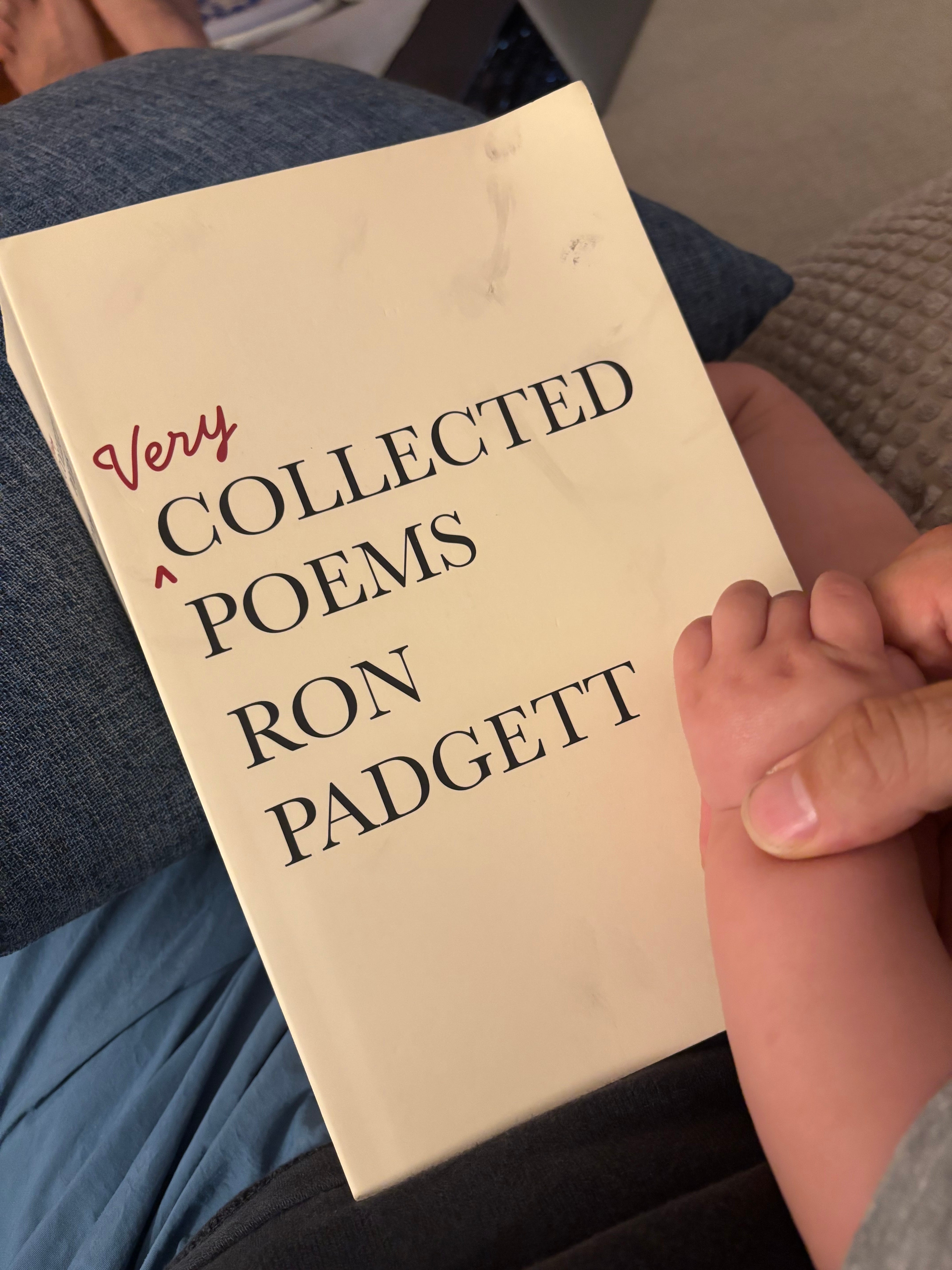
This tome is Padgett’s second book of collected poems, which is bonkers. And funny. Very funny. And too: a cause for great joy, as so many of Padgett’s poems are these inviting things. They say look. They say be here with me. They so often, as today’s poem does, sit in a moment and refuse to leave it in order to make such a moment grander than it is. It’s not a poetry of escape, Padgett’s poetry, but rather a poetry of staying put, briefly, in this brief thing we call a life.
I’m going to return to Padgett’s poems after a bit of an extended digression, which is to say: I’m thinking of his poems, in part, because of a recent review that ran on this platform about a contemporary poet’s newest collection, comparing her work to Mary Oliver’s, and linking the two female poets together as part of a romantic tradition that worked in opposition to rationality. There was an implication that both poets were on the side of the emotional and sentimental in ways that made their work thoughtless, ignorant of the rational. The reviewer labeled both poets as feminine, generic, simple, easy, accessible, and dispensable.
I’m less concerned with directly responding to this specific review, and more concerned about the history in which it takes part. In other words: it made me think about some patterns in criticism that I’d like to think aloud about, particularly in regards to the way sentiment and emotionality is treated when it is written by women, with Mary Oliver as a prime example.
People called out the review for the inherent misogyny embedded within such descriptors of sentimentality, emotionality, simplicity, femininity, and more. And, to be frank, I agree with this. I’d argue, too, that there’s a kind of misogyny in presenting two female poets as writers on the side of emotion over reason. I think every critic has a responsibility for understanding the long scope of history that they operate within, paying careful attention to the harm perpetrated by other critics who have placed women on one side of that line (as emotional beings opposed and perhaps even incapable of reason or thought). It’s a dangerous thing, I’d argue, to even hint at, and it makes me question the very purpose of upholding such a strict dichotomy—that those governed by reason do not engage in the act of feeling emotions, and those governed by emotions do not engage in the act of thought itself. There’s a long, not-so-great lineage of people who have made such a distinction, often at the expense of women.
I think of how Richard Wright, quite infamously, panned Zora Neale Hurston’s Their Eyes Were Watching God, as a “facile” book (read: easy, unthinking), that had “no theme, no message, no thought.” Alain Locke couched his own thinking in a slightly more generous review that still claimed that the novel was an “oversimplication.” Hurston died in a welfare home and was buried in an unmarked grave, where her body remained for thirteen years until a woman, the writer Alice Walker, journeyed to find it, thus re-dignifying her name and restoring her legacy. It feels impossible to read Hurston’s novel now—with its language that somehow manages to dig a shovel into the ground while at the same time picking off stars from the sky, and with its depictions of speech that are a testament to Hurston’s field recordings as an anthropologist—and imagine it as a thoughtless, simple novel.
I think, too, of how, in Advertisements for Myself, Norman Mailer called writing by women “fey, old-hat…tiny…crippled, creepish, fashionable, frigid…or else bright and stillborn.” I’m leaving out some of the more horrid parts, to be quite honest.
Some bad stuff, there is, in the history of criticism.
I would be hard-pressed to call what I do here in this newsletter a form of criticism. I think of it mostly as a kind of ongoing practice of appreciation as well as my own personal opportunity to write into an act of careful attention that starts with a poem and often ends with myself, or the world, or something in between. I don’t imagine I would start one of these meditations with a poem that I did not enjoy, or at least appreciate in some way. That being said, I think that there is absolutely a place for the negative review in criticism; at its best, it can be an absolute treat to read someone with discernment and style apply such skills of thought and craft in a way that makes me alter my own sense of taste and, perhaps more importantly, my own approach to reading. Imagine if you ate an apple, thinking it juicy and crispy and above all other apples, only for someone to actually—and I mean actually—convince you that it was not. It would feel a type of magic, as if someone had un-tasted a past taste for you, had made you think again about what you thought you knew. There is real joy there, and skill.
But such attempts fail when they succumb not just to plain meanness, but also to the very traits that they often accuse their targets of displaying: generalities, dichotomies, rigidities of thought rather than expressions and explorations of curiosity.
At its best, criticism is generous. I don’t mean that it is overly or overtly laudatory, which is partly why I’d argue that I am not, myself, a critic. I do lots of lauding here. Very much so. I mean that it seeks deeply to understand the subject of its gaze, rather than to merely judge it. Some of the best recent examples I’ve read have come from The Yale Review. In a particularly generous paragraph of her piece on Mary Oliver, Maggie Millner unpacks the possible complexity underneath the surface of Oliver’s work:
In the poems I like best, this experience of self-forgetting feels genuine, but in others, it can feel generic and contrived: less like transcendence, more like avoidance. As she writes in “Dogfish”: “You don’t want to hear the story / of my life, and anyway / I don’t want to tell it, I want to listen // to the enormous waterfalls of the sun.” As I watched Oliver repeatedly dodge her reader, it occurred to me that the self-consciousness I felt while reading might be a mirror of the author’s own—and that the embarrassment I’d been struggling to swallow might actually help me find new valences in her poems.
This is what I mean by generosity. Millner refuses to succumb to her own taste, and, as such, stumbles into new readings of Oliver’s work rather than pigeon-holing herself into her original one. This, to me, is one of the joys of reading thoughtful criticism: I learn less what to think of a specific work, and more, instead, about how to think about all work. I imagine that writing good criticism feels rewarding in this way—the critic surprising themselves, as Millner does, into newfound insights, rather than spending their time digging a deeper hole to fortify the insights they already have.
I think, too, of Garth Greenwell’s writing on Philip Roth, and how he uses Roth’s Sabbath’s Theater as a way to examine his own relationship (and our culture’s relationship) to what we claim to abhor:
The wonder of Sabbath’s Theater, the measure of its achievement, is that after 450 pages with this intolerable man I don’t want to turn my back on him. I can’t, because I’ve come to cherish him. This posture, of finding another intolerable and at the same time cherishing their existence, is deeply uncomfortable and urgently necessary. Because, at least in part: what’s the alternative?
The best critics, I think, are actually able to hold competing dualities and dichotomies within the wide breadth of their minds, rather than to merely judge by the already-set-up yardsticks of the past or present. The latter is an easy task. You grow up into a world framed by opposition, constantly asking you to choose a side. Surely there are some areas of life where it is important and just to choose a side. Vital, even. But in the world of literary criticism, I care less about holding up pre-existing poles (good versus bad writing, emotion versus reason, formal versus informal, men versus women, and so on, and so on), and more about the way a critic might navigate their own tastes, the varied moods of the current culture, our collective politics, and the wide scope of literature writ large to offer me a way of seeing and a way of thinking that feels new and expressive rather than tired, old, and oppressive. This can be done in a review that pans something. It can be done, truly, in all sorts of ways: with great seriousness, with great joy, and with great style. Such criticism deserves to exist, as it makes us better readers, and, to be frank, often more aware, discerning people. Which is to say: better people. A nice side effect. It is a shame that so many legacy media outlets have disbanded their book reviewing sections and writers, as The Washington Post did not so long ago.
Anyway, all of that brings me to this poem today by Ron Padgett, who I love (remember—I am laudatory). I’ve been thinking all week about the portrayal of someone like Mary Oliver as unthinking, or simple, or feminine, or generic—a portrayal that, I’d argue, does not offer me a new or expressive way of thinking and instead attempts to lock me into an oppressive, restrictive way of thinking. It’s a portrayal, too, that is quite tired. Many people who call themselves poets have been embarrassed, as Millner interrogates, to name their love for Oliver’s work, often hiding such love behind conditions (“I know she’s a sentimental poet, but…”). Even her praiseworthy reviews are sometimes framed in a way that assumes the reader is already coming to the table with a less-than-stellar opinion of Oliver.1 Though Oliver was commercially successful for a poet, her critical perception has long been stained by, I’d argue, a gendered and archaic judgment that finds her poems too full of feeling, or wistfulness, or nature, or easiness, or more. Too simple, even. Too accessible to be a real poet. One must apologize for loving her. What a shame!
And so, enter Ron Padgett, who utilizes a vocabulary often more pared down than Oliver’s, and who loves the natural world, and who even, if I were to bring out that dichotomy between emotion and reason, perhaps “feels” more than Oliver. So many of his poems end within a moment of pure feeling, resonating. Here’s one of my favorites, in full (the title of which is also the poem’s first line):
In the winter of 1969-70
I went out to an old shed
behind Fairfield Porter's house
and fired up the coal stove,
cleared a spot on a workbench,
sat down and started translating
the poetry of Blaise Cendrars.
Sometimes the room got so hot
I'd open the door wide open
and outside snow was falling,
It was one of the happiest times of my life.
Or consider today’s, which lingers in the sweetness of a moment but doesn’t attempt to make anything out of it. This, I’d say, is the crucial difference between the two poets. Oliver’s poems often move deeper into the world, tired or lonely or in love or ashamed or so much else, sometimes hoping for answers, sometimes hiding from them, sometimes seeking, sometimes not. She writes, in “The Poet Dreams of the Mountain”:
Sometimes I grow weary of the days, with all their fits and starts.
I want to climb some old gray mountain, slowly, taking
the rest of my lifetime to do it...
She leaves things and people behind, as she writes in “The Journey”:
But little by little,
as you left their voices behind,
the stars began to burn
through the sheets of clouds,
and there was a new voice
which you slowly
recognized as your own,
that kept you company
as you strode deeper and deeper
into the world...
She searches for feeling, too, as she writes in one of my more beloved poems of hers, “Coming Home”:
our life
moving like that,
along the dark edges
of everything — the headlights
like lanterns
sweeping the blackness —
believing in a thousand
fragile and unprovable things,
looking out for sorrow,
slowing down for happiness,
making all the right turns
right down to the thumping
barriers to the sea...
Padgett’s poems are often content to remain exactly in the feeling of the moment. He writes, in “Inside Happiness”:
Let's get inside a song
and live there,
happy in its refrain,
happy to be in it
again and again,
always the same.
His poems even sometimes, with great humor, resist the impulse to wander towards meaning, as he writes in “Infusion”:
It feels cold in this room
until I go outside.
Is that a metaphor
waiting for its meaning?
Probably.
Isn't everything waiting for its meaning?
Go ahead,
infuse everything with meaning.
See how far it'll get you.
If I were still trying to use that limiting dichotomy of emotion versus reason, I’d actually argue that Padgett’s poems are more “emotional” than Oliver’s, in that they sit entirely in the midst of a feeling, while Oliver sometimes tries to move a feeling toward meaning, which is in and of itself a process of thinking. Sometimes Oliver tries to escape a feeling, while Padgett does not. And doesn’t all escaping contain a form of thinking? How, in other words, to get out?
Once again, I adore both of these poets. I really do. It is possible to deeply enjoy writers who do different things. But consider, though, how Oliver has been portrayed in the critical world. There’s David Orr’s oft-quoted New York Times Book Review dismissal of Oliver as a poet “about whose poetry one can only say that no animals appear to have been harmed in the making of it.” William Logan, infamous for his barbs, called her “the poet laureate of the self-help biz,” describing one of her books as a “naked set of values.”
Now consider how Padgett—whose work might, when approached with a shallow form of attention, be described as approachable or accessible—has been portrayed. Here’s some snippets of a Jeff Gordinier review in The New York Times:
In “Pep Talk,” he fearlessly defies writing instructors everywhere by using the word “nice.”
Among male poets, though, the preservation of a stubborn streak of boyishness can feel like an advantage.
In another review, even Padgett’s approachability and easiness is described in pyrotechnic (!) terms:
What Padgett does can so seem easy — and in some sense it is — that it leaves the reader (this one, at least) astounded and delighted, smiling. His pyrotechnics never seem, well, pyrotechnical.
The treatment of Padgett is different than that of Oliver, wildly so. His use of a word (nice) that some might call generic is an act of fearless defiance. Later, in the former review, his writing is described as “puckish” and “unadorned.” What would be lambasted as simple for someone else (ie. Mary Oliver, or another female poet) is given these admirable, energetic words.
I’d argue that a number of male poets who have been historically lauded write with the same fervent love of nature as Oliver, with the same degree of vulnerability that lends itself to the naming of emotions that often gets characterized, when Oliver or another female poet does it, as a kind of cloying, dripping sentimentality. “I had complaints about her early poems,” William Logan wrote of Carolyn Forché, “chiefly that they were sentimental.” In that same collection of reviews, Our Savage Art, he described Tess Gallagher’s poems as “sentimental routines” written by a “drama queen.”
Now consider Jim Harrison. Yes, that late, wise, beloved, poet-novelist out in Michigan and Montana with his one blind eye and his love of dogs. God, I love him. But don’t his poems also have a unvarnished approachability and a willingness to simply name a feeling, to be astonished? Is he sentimental? Simple? Thoughtless? In one poem, from Songs of Unreason, he even resists the rationality of humans, writing “I’ve chosen birds and fish, the creatures / whose logic I wish to learn and live.”2 But he is not characterized as an emotional poet in some negative way because of this resistance to reason. No, according to The New York Times, he is a man’s man, a poet hanging out on the outskirts, tenaciously and doggedly surviving and trying:
Hanging out in Los Angeles, pursuing the life of the screenwriter, he himself must have felt like a weed, a tough, dogged evolutionary product tenaciously flourishing in an alien landscape.
Or consider W.S. Merwin, who, as his career evolved, wrote poems of absolute softness and feeling. So much feeling. I mean, consider this oft-circulated short one, “Wish,” which reads, simply, “Please one more / kiss in the kitchen / before we turn the lights off.” Here’s how his work was described in the Times by Dwight Garner:
In his reverberating brand of free verse, lines hover in the air like pulses of distant starlight, or humming throws from deep right field to home plate.
Pulses! Humming throws! My gosh. More so, in that same David Orr piece mentioned above, he follows his dismissal of Mary Oliver with his own assertion that one of the only “admirable features” of the feature that included Oliver’s work is “a profile of W. S. Merwin.” Funny, that fact.
Or think, too, about a novelist, Larry McMurtry, whose novel Lonesome Dove is tender and big-hearted and romantic, having offered me one of the most joyous reading experiences I’ve ever had. But couldn’t he be called wistful? Simple? Dripping with sentiment? According to the Times, he is the writer of the “Great Cowboy Novel.” Indeed, in writing about one of his later books, the paper even pointed out his sentimentality, arguing not that it made his work simple or thoughtless or overly emotional, but rather that it worked for him, even if such a thing would be a death knell for a different writer:
Mr. McMurtry's is sentimentality laced with comic irony, and it works very well. I can't believe some of the things he gets away with.
Or how about Wendell Berry—who writes with real moral clarity and a deep, abiding love for the land, who one might argue is even more of a pastoral poet than Oliver herself? If he is, it is no strike against him, since, in one review of his collected poems, Berry is said to have “returned American poetry to a Wordsworthian clarity of purpose.” The reviewer goes on:
There can be no doubt Mr. Berry has labored for that knowledge, which he shares through his poems. One can feel the effort to say rightly what must be said.
Labor. Work. Effort. A refusal to be easy. The truth is—I don’t disagree with any of these reviews. I find Padgett’s writing puckish. I think of Wendell Berry as a laboring advocate for a more just and moral relationship to our land. And god, I can’t say a mean thing about Larry McMurtry, whose books I read when I want to be reminded about why I love to read. But it is strange to me that such critics are able to move through shallower identifications and into deeper, more complicated insights for these men, and yet, when it comes to someone like Mary Oliver, or another woman, they remain forever in the shallow end of the pool, pointing a finger rather than plumbing the depths.
I think again of those lines cited by Maggie Millner in her essay for The Yale Review. They are from Oliver’s poem, “Dogfish,” which ends:
And look! look! look! I think those little fish
better wake up and dash themselves away
from the hopeless future that is
bulging toward them.

And probably,
if they don’t waste time
looking for an easier world,

they can do it.
Just like someone might argue of Berry, Oliver, too, resists a kind of easiness. She labors; she points towards the work. Here, in “Breakage,” she does it again, looking at what is left at low tide on the shore:
It's like a schoolhouse
of little words,
thousands of words.
First you figure out what each one means by itself,
the jingle, the periwinkle, the scallop
       full of moonlight.

Then you begin, slowly, to read the whole story.
She is teaching us, here, the hard, intentional work of reading. Funny, then, how her work is not often described in such a way, how it is not described as work, how she is not someone characterized as laboring for her knowledge.3
In an essay for Poetry, the writer Alice Gregory wrote, of those who leap quickly to shallow judgments of Mary Oliver’s work:
But you miss a lot by allowing the large language to overshadow the more muted connective tissue. Paying such crude attention will not grant you the fortifying effects Oliver has to offer.
Crude attention is, I think, one of the worst things that can inform our criticism, because, I also think, it will predispose us to follow our more awful judgments rather than, as a more generous attention might allow, prompt us to surprise ourselves into insight.
I think that when we read, we are influenced by a great deal of things. We are influenced by biases we both know and do not know we have. We are influenced by the culture we live within, by our politics, by our lives. I don’t think, really, that we live, right now, within the greatest culture to influence a more generous style of reading. We are trapped in an age of virality, where snap judgments defined more by their intensity than their depth have more sway than insights deepened by a rigorous generosity. I think people are sometimes scared to admit that they like things, and are quick to admit that they don’t. I think we live in a culture that creates easy targets, and someone like Mary Oliver is one of them. Pay shallow attention, and you become a mirror of the very things that influence your lack of attention: Instagrammability, share-ability, consumption. Such things make us worse readers, or no readers at all. All the more reason, then, to resist such quick judgment. To refrain from holding up the goalposts that are already being held up for us. The poems that inform our criticism have already been written. It is our criticism, then, that adds newness to the world, or that reifies what is old and tiresome. There is great power in such an act. We should be better for it. We should certainly not be worse.
In a bit of a side quest as a cycling journalist, I had the pleasure of writing about the Tour de France on three separate occasions for the cycling magazine Escape Collective. You can read all three pieces here.
My novel, Pilgrims, is out in the world, and I am deeply grateful. Thank you for reading it and sharing it and all sorts of things. If you are interested, you can buy it here. Consider writing a review on Goodreads if you’d like. Consider asking for it from your local library. I appreciate it. Thank you a million times over.
If you’ve read any of the recent newsletters, you’ve perhaps noticed that I am offering a subscription option. This is functioning as a kind of “tip jar.” If you would like to offer your monetary support as a form of generosity, please consider becoming a paid subscriber below. There is no difference in what you receive as a free or paid subscriber; to choose the latter is simply an option to exercise your generosity if you feel willing. I am grateful for you either way. Thanks for your readership.
For example:
He really loves birds. In another poem, he writes:
I love these raw moist dawns with
a thousand birds you hear but can't
quite see in the mist.
By the way, as a bit of an aside, earlier in that poem, “Dogfish,” Oliver writes:
You don’t want to hear the story
of my life, and anyway
I don’t want to tell it, I want to listen

to the enormous waterfalls of the sun.

And anyway it’s the same old story–
a few people just trying,
one way or another,
to survive.
Here are some lines from the opening of Larry Levis’ “God Is Always Seventeen”:
Besides, I can’t imagine a body in the first faint stirrings of arousal
Without feeling sorry for it now, & anyway, I’ve built a fire in the fireplace

And I don’t have a fire screen yet, & have to watch it until it goes out,
Even the last lukewarm ember. It isn’t my house.

It belongs to a bank in St. Louis somewhere & they have four thousand
Different ways to punish me if the place goes up in flames, including the guys

From Medellín who work for them now & specialize in pain.
Besides, it’s still winter everywhere & maybe you want to hear a story

With a fire burning quietly beside it.
You hear it, don’t you? The anyway? The repeated, insistent self-deprecation? The shame? Perhaps no one would place Mary Oliver alongside Larry Levis and say hey, listen to this conversation, but I would. They are talking about shame. They are talking about fear. I don’t know how much they like themselves. Or how much, in these moments, they like life. Though they are living life. And writing into it. And yet, there is one key difference. In Levis’ poem, he assumes you want to hear the story. In Oliver’s poem, she assumes you don’t. Whew. There’s a real sorrow there. I would call it brave, courageous—to still write toward an audience that sometimes made it clear how little they wanted to hear your story, and how poorly they would seek to understand it.
Very grateful for your support here AND for the lovely reading of Padgett. Thank you so much.
— A “girlie diarist” poet
Sad that some critics, in their self-absorption, miss the simple complexity of a life lived. Thanks for the lovely passages and thoughtful reflection. I’m off to read more Oliver, Padget, and live this day. I might even write about birds or the green tree frogs clinging to the glass panes of the back door.